


PlatiGleam in Angkor Wat: My Journey Through Light and Shadow
- Nelson Ferreira
- Oct 8, 2025
- 2 min read
Updated: Oct 17, 2025
I have always been drawn to the silent, sacred spaces of the world—places where history, spirituality, and architecture converge. Over the years, I have painted in many UNESCO World Heritage sites, each one teaching me something new about the human spirit. But this September, I stepped into Angkor Wat to paint for the first time there, carrying with me the vision and discoveries born from my residency at Borobudur, Indonesia. There, I had experienced the profound privilege of creating the first-ever documented solo exhibition at the world's largest Buddhist temple, a moment I will never forget.
Then, I was honoured to be named Cultural Ambassador by InJourney Destination, and invited to do the first artist residency in Angkor Wat, Cambodia, under the Twin World Heritage Programme, supported by GIZ Cambodia. At Angkor Wat—the largest religious monument in the world, spanning 163 hectares—I spent seven sunrises creating a new body of work, again visible only through the moving glow of a mobile light. Conceived during the September equinox, these works respond to the temple’s cosmic symbolism, establishing a dialogue between PlatiGleam paintings and such sacred architecture. In its 900-year history, the temple had never before hosted an artistic residency of this kind.
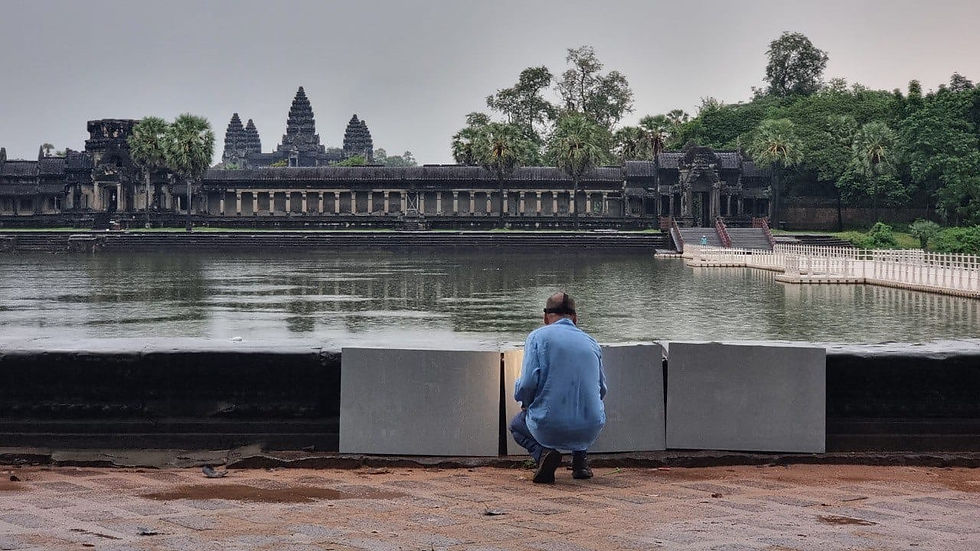
Using my PlatiGleam technique, I created paintings that remain invisible until revealed only by certain kinds of light. No pigment, no immediately visible brushstrokes—only the potential for vision to emerge from darkness. I watched the night-shift staff, guardians of this timeless place, encounter PlatiGleam for the very first time. Their awe reminded me why I do this work: to transform perception, to invite wonder, and to make the unseen seen.
I first presented PlatiGleam in 2023 at Portugal’s Batalha Monastery, in the exhibition Mist, which welcomed over 127,000 visitors. One of the paintings entered the monastery’s permanent collection and has since been seen by over a million people. Later, I extended PlatiGleam to the temples of Nepal, exhibiting in Kathmandu Valley, Durbar Square, and at the Nepal Art Council.
Through PlatiGleam, I strive to redefine how audiences experience UNESCO World Heritage sites. Darkness becomes light. Silence becomes contemplation. Architecture becomes again a dialogue with the cosmos. And in these quiet, hidden moments, I hope every viewer—every pilgrim of light—feels that same spark of connection that continues to inspire me. Back at Borobudur, a 9 x 6 metre gallery now preserves these nocturnal creations for long-term display.

